Quick answer
You should choose a standard filter if your water quality is already pretty good and you only need to improve it marginally. A standard water filter can improve taste, remove chlorine, and reduce sediment.
Opt for Reverse Osmosis (RO) if you live in a rural area with bore water, a region with hard water, or if you specifically want to remove fluoride, PFAS, and heavy metals from the water supply.
What we mean by a “standard” water filter (and what it’s not)
When we refer to a standard water filter, what we mean is an under-sink carbon and sediment (optionally UF) filter system. The under-sink carbon and sediment filter system provides clean water by removing particles and chemicals, like chlorine, to improve taste and odour. These systems are easy to install and connect directly to the water line for what’s known as point-of-use filtration.
What is reverse osmosis (RO) and how does it work?
Reverse Osmosis is a multi-stage water purification system that uses pressure to force water through a semi-permeable membrane to reduce dissolved contaminants, such as salts, minerals, bacteria, and viruses.
RO works by applying pressure to the feed water and pushing it against the membrane, which only allows water to pass through. This creates highly purified water (known as permeate) and a concentrated waste stream (known as brine).
RO in plain English: membrane + prefilters + (optional) remineralisation
The process begins with prefilters that use sediment and carbon to trap and remove dirt, large particles, and chlorine. This protects the membrane from chemical damage and clogging. Then the core RO membrane strips away up to 99% of contaminants. A post-carbon filter provides a polish to improve taste, and optional remineralisation adds healthy minerals back in to balance pH and improve taste.
What “wastewater” is and why it happens
Wastewater is the leftover liquid with all the contaminants that were unable to pass through the RO membrane. The flush water that carries away concentrated impurities is called either the concentrate, reject, or brine. All three terms mean the same thing and are used interchangeably. Ratios of pure water and brine vary by system and water pressure.
The key differences
|
Feature |
Standard Filters |
Reverse Osmosis (RO) |
|---|---|---|
|
TDS & Minerals |
Leaves minerals and fluoride intact; minimal impact on TDS. |
Reduces total dissolved solids by up to 99%. |
|
Taste & Chlorine |
Effectively removes chlorine taste and odour. |
Removes chlorine plus metallic or salty notes. |
|
Water Waste |
Zero waste. |
2–3 litres of waste (brine) for every litre purified. |
|
Space |
Typically fits directly on the tap or inline. |
Requires under-sink space for the system and storage tank. |
|
Maintenance |
Cartridges are usually swapped every 6–12 months. |
Annual pre-filter changes. Membrane replaced every 2–4 years. |
If you care most about simple, eco-friendly chlorine removal and saving space, go for a standard filter. However, if you care more about achieving the highest possible purity and removing heavy metals or salty aftertastes, RO is worth the investment.
What each system removes best (chlorine vs dissolved solids)
Standard carbon filters primarily remove chlorine, whereas Reverse Osmosis uses the fine membrane to block almost everything else. Think of standard filters for minor aesthetic improvements, like chlorine, taste and odour, and RO as dissolved solids reduction.
Standard filters excel at removing chlorine for improved taste, while Reverse Osmosis (RO) systems are far better at removing dissolved solids (TDS), heavy metals, salts, minerals, lead, fluoride, and bacteria. RO offers superior water purity, but also wastes water and removes beneficial minerals.
Taste & mineral content (why RO tastes “cleaner” to some)
RO removes most of the healthy minerals that affect the water’s taste. Because of this, RO can taste cleaner and more preferable to some, and more bland and tasteless to others. Remineralisation is an optional, additional step that can be added to your RO system to re-add minerals and, subsequently, the taste, back to the water.
Flow rate & convenience (fast pour vs slower tank fill)
Standard filters have a fast, steady stream. This makes it easier to fill a large kettle or cooking pot. RO systems filter water much more slowly through a storage tank to provide the needed pressure. However, if the tank runs dry, the flow drops significantly. While perfect for filling water bottles, RO may be less convenient for heavy kitchen tasks such as filling a large pot.
Maintenance complexity (simple cartridges vs multi-stage)
Maintaining a standard filter is more straightforward and usually requires fewer cartridges. A standard filter only needs a single cartridge swap once or twice a year.
RO systems are more work but are still manageable. The multi-stage schedule involves annual pre-filter changes and a membrane replacement every few years. Using service kits and setting calendar reminders makes the process simple and predictable.
Pros and cons
Standard filters — best upsides and trade-offs
Standard filter owners appreciate the lower upfront cost, better and faster water flow, and the complete absence of reject water. However, some trade-offs include the standard filter’s inability to get rid of TDS and the need for additional media to get rid of other contaminants. With that being said, standard filters are still the right tools for the job if you want to remove chlorine and have better-tasting water.
RO systems — best upsides and trade-offs
RO is the gold standard for absolute purity, although it requires a dedicated space for a permanent under-sink setup. RO water removes more dissolved solids and has a consistency and purity you can taste.
The downside is that there’s a higher upfront cost, it’s a more complex system with more parts, and the water filters through a storage tank, making the flow much slower. RO also produces reject water, which standard filters don’t.
Which one should you choose?
Choose a standard filter if you…
-
like the mineral taste
-
want to keep minerals in the water
-
want to remove the chlorine smell
-
want a high flow
-
prefer a simple setup and maintenance
-
have limited space under your sink
Choose RO if you…
-
dislike the mineral taste
-
have high TDS/hardness in your water
-
want low-TDS for coffee, tea, or ice
-
are on tank/bore and want multi-stage
-
are okay with additional maintenance and space
The common “best of both” setup: whole-house + RO drinking tap
A whole-house system is a single filter installed at your main water line that treats all the water entering your home and protects your showers and appliances from chlorine and scale. A dedicated RO tap then provides purified water for drinking and cooking. This is a popular way to enjoy soft water throughout your home without sacrificing the filtration levels of RO at the kitchen sink.
Installation options and tap choices
Both standard and RO can be delivered via a separate filter faucet or 3-way mixer in the kitchen. Of course, this will widely depend on the flow and the system. You should always check compatibility before purchase and installation.
3-way mixer tap vs separate filter faucet (and when each is better)
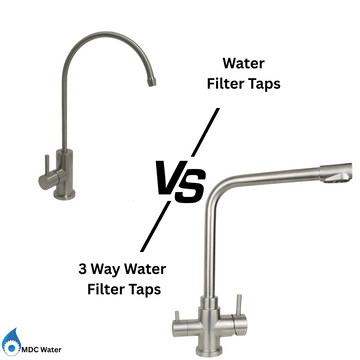
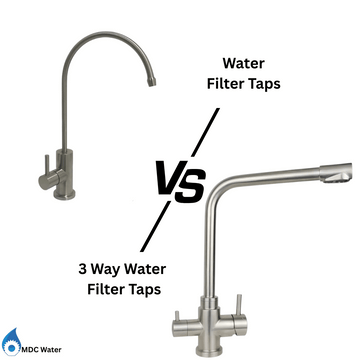
A 3-way mixer tap combines hot, cold, and filtered water into one sleek spout, which many like for its minimalist design. A separate filter faucet offers two spouts with simpler and often cheaper installation. A separate faucet usually has a slower, filtered water flow without the extra plumbing complexity.
We recommend the 3-way for integrated style and kitchens that need to save space, and the separate filter faucet for lower cost or when you already have a bench hole in the sink.
RO vs standard water filter: What we recommend
If you want a simpler, space-saving filter that improves taste and keeps the natural minerals, a standard filter is your best bet. If you’re after the highest level of purity and the removal of heavy metals, salty minerals and other contaminants, go with RO.
We recommend choosing a standard filter if you live in a major city like Sydney or Melbourne, where tap water is already high-quality. Contact us to find the right water filtration system for your home today.
FAQs
Is RO water the same as distilled water?
Although both are highly purified, RO uses a semi-permeable membrane to filter contaminants while retaining some minerals for better taste. Distillation works by boiling water, collecting steam and stripping nearly all minerals. Distilled water is purer but has a blander taste. RO can also taste flat to some.
Does RO remove “good minerals” — do I need remineralisation?
RO reduces minerals, but the difference in nutritional value is minimal. Most essential minerals come from food, so the only reason to remineralise would be for taste preference.
Does RO waste a lot of water in Australia?
Yes, typically RO systems produce 2–3 litres of reject for 1 litre of pure water. Ratios do vary by the system and amount of pressure, though. However, newer systems are more efficient and sustainable, with some even reaching 1:1 ratios.
Can a standard carbon filter remove fluoride / heavy metals?
Standard carbon filters are generally bad at removing fluoride and only partially remove some heavy metals. For fluoride, you’ll typically need specialised filters like Reverse Osmosis or carbon block filters with added media (such as Kinetic Degradation Fluxion) for effective removal.
What’s cheaper long-term: RO or a standard under-sink filter?
A standard under-sink filter has a lower upfront cost and is a simple system to install and use. RO can cost more over time due to the use of multiple filters/membranes, but the total value depends on goals.
Do I need a plumber to install an RO system?
Fortunately, many kits are DIY-friendly for confident homeowners and can be installed without help. A plumber may be safer for compliance reasons or leaks. If you’re unsure, it’s best to call a licensed plumber for a professional installation.
Can I run RO water through a 3-way mixer tap?
Yes, commonly, but compatibility depends on:
-
pressure
-
flow
-
tap specifications
-
(whether) RO uses a tank
You should check the tap and system’s compatibility first before running it through a 3-way mixer tap.